
Krishna's Symbols: The Meaning Behind the Flute, Peacock Feather & More
Discover the stories and symbolism behind the flute, peacock feather, cows and other timeless symbols associated with Krishna.
📚 Athizay Krishna Heritage Series - Part 3
Exploring the stories, symbolism, traditions and artistic expressions that continue to keep Krishna's heritage alive across generations.

From the Child Krishna to the Symbols of His Story
In Part 1 of the Athizay Krishna Heritage Series, we explored why Janmashtami continues to hold such a special place in Indian culture and the story surrounding Krishna's birth.
In Part 2, we journeyed into the world of Laddu Gopal, discovering how Krishna's playful childhood, his butter stories and his affectionate relationship with those around him made the child form one of the most cherished expressions of Krishna's heritage.
But as Krishna's story unfolds, certain objects, animals and natural elements appear again and again.
A flute resting against his lips.
A peacock feather adorning his crown.
Cows surrounding him in the pastoral landscape of Gokul and Vrindavan.
A lotus, often associated with purity and spiritual beauty.
And the river Yamuna, deeply connected with the stories of Krishna's childhood.
These are not merely decorative details.
Over centuries, they have become some of the most recognisable symbols associated with Krishna.
So, what do they represent?
And why have artists, storytellers and devotees continued to place them alongside Krishna?
Why Are Symbols So Important in Krishna's Story?
Indian traditions have long used visual symbols to communicate ideas that can be difficult to express through words alone.
A single object can connect a person with an entire story.
The flute can immediately evoke the image of Krishna standing in Vrindavan.
A peacock feather can bring his familiar crown to mind.
A cow can recall his childhood among the cowherds.
In this way, symbols become a visual language.
They allow stories to travel across generations — even when someone may not know
every detail of the original story.
This is one reason Krishna's imagery has remained so recognisable across paintings,
sculptures, textiles, temple art and contemporary representations.
The Flute — Krishna's Most Recognisable Symbol
Few objects are as closely associated with Krishna as his flute.
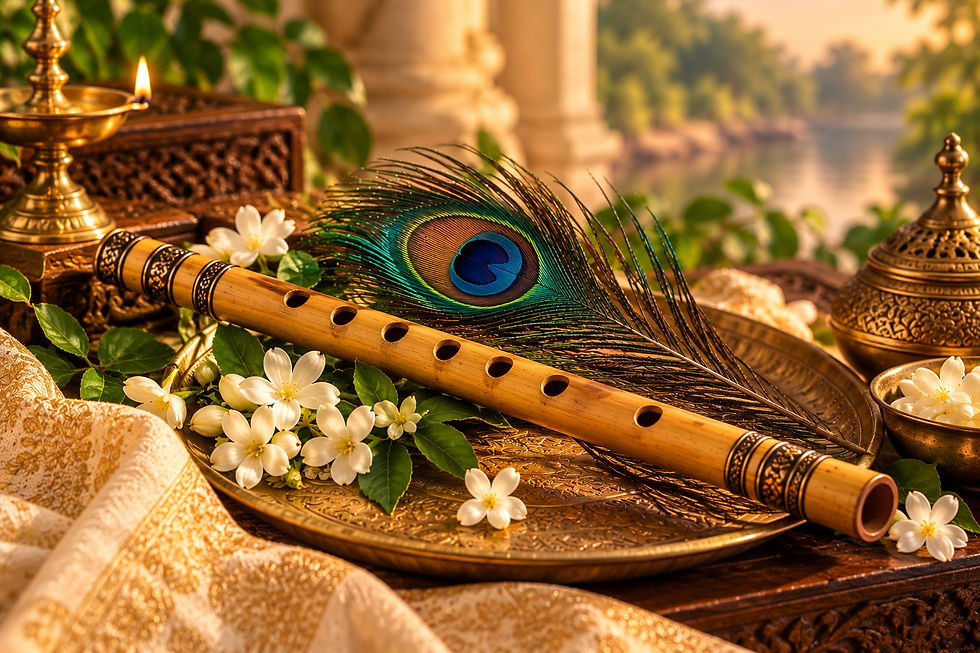
In artistic representations, Krishna is frequently shown standing gracefully with the flute held to his lips, often accompanied by cows, trees or the pastoral landscape of
Vrindavan.
The flute is traditionally associated with the music that Krishna plays and the way that music draws those around him toward him.
Within devotional traditions, the sound of Krishna's flute is often understood as a call that awakens love and devotion.
But there is another beautiful quality to the flute itself.
A flute is hollow.
It produces music because air is allowed to pass through it.
This has inspired a powerful symbolic interpretation: the human being, like the flute, becomes an instrument when the ego makes space for something greater.
The flute therefore represents not only music, but also devotion, surrender and the possibility of becoming receptive to the divine.
Why Is Krishna's Flute Called Bansuri?
The word bansuri is commonly used for the traditional Indian bamboo flute.
The instrument is made from bamboo and produces its distinctive sound through carefully placed openings along its length.
The bansuri is strongly associated with Krishna in Indian cultural and devotional imagery.
Although the precise forms and traditions surrounding Krishna's flute vary across stories and artistic traditions, the visual association has become so powerful that even a simple flute placed beside a Krishna figure can immediately identify him.
This is the strength of cultural symbolism.
The object becomes inseparable from the story.
The Peacock Feather — Beauty, Nature and Krishna
Another instantly recognisable symbol of Krishna is the peacock feather, traditionally shown adorning his crown.
The feather brings colour and movement to Krishna's imagery, but its significance goes beyond ornamentation.
The peacock itself is a beautiful part of India's natural heritage, and the feather's distinctive pattern has made it an enduring artistic motif.
In Krishna's imagery, the feather complements his connection with nature and the pastoral world of Vrindavan.
It also adds a sense of playfulness and beauty to his appearance — qualities strongly associated with the youthful Krishna.
Across paintings, sculptures and decorative traditions, the peacock feather has therefore become almost inseparable from the familiar visual identity of Krishna.
Why Does Krishna Wear a Peacock Feather?
Traditional stories and later devotional interpretations offer different ways of understanding Krishna's relationship with the peacock feather.
Rather than treating one symbolic interpretation as the only meaning, it is useful to appreciate how the feather has accumulated associations over time.
It represents beauty, nature and grace, while also reinforcing Krishna's connection with the natural world around him.
The peacock feather also has an important artistic function.
Its curved shape and vivid pattern create a natural visual contrast against Krishna's crown and hair, making the figure instantly recognisable.
This is one reason the motif has remained so powerful in Indian art.
The Cow — Krishna as Gopal
If the flute represents Krishna's music, the cow represents another essential part of his childhood story.

Krishna is widely known as Gopal and Govinda, names associated with his relationship with cows and his life as a cowherd.
The pastoral world of Gokul and Vrindavan is central to many stories of Krishna's youth.
He is remembered walking among the cows, playing his flute and spending time with his friends in the countryside.
The cow therefore connects Krishna with care, pastoral life, nourishment and the natural world.
It also helps us understand why Krishna's childhood stories feel so different from his later life as a prince, statesman and spiritual teacher.
In Gokul, Krishna belongs to the landscape.
Krishna and the Natural World
Krishna's imagery is rarely isolated from nature.

Trees, flowers, birds, rivers and animals frequently appear around him.
This is particularly evident in artistic representations of Vrindavan, where Krishna's childhood stories unfold among forests, pastures and the banks of the Yamuna.
Nature is therefore not simply a background.
It is part of the story.
The flute, peacock feather, cows and flowering landscapes collectively create the visual world through which generations have imagined Krishna's childhood.
The Lotus — A Symbol of Purity
The lotus occupies an important place throughout Indian art and spiritual traditions.
It is often associated with purity because it grows in water while rising above the surface with an unsoiled flower.
The lotus appears across Indian religious and artistic traditions, including representations associated with Krishna and other Hindu deities.
Its presence can therefore add another layer to Krishna's visual language — connecting beauty with spiritual aspiration.
Like many symbols in Indian art, its meaning is not restricted to a single story.
Instead, it forms part of a wider cultural vocabulary shared across generations.
The Yamuna — The River of Krishna's Childhood
The Yamuna River holds a particularly important place in Krishna's childhood stories.
According to traditional narratives, Krishna's early life is closely connected with the
Yamuna and the landscape around Vrindavan.
Stories associated with the river — including the well-known episode of Krishna and the serpent Kaliya — have become part of India's rich storytelling and artistic heritage.
The Yamuna therefore represents more than a geographical feature.
It is part of the landscape in which Krishna's childhood stories come alive.
The Kadamba Tree and the Landscape of Vrindavan
Trees and forests also play a recurring role in Krishna's stories.
The Kadamba tree, in particular, appears in traditional accounts associated with
Krishna and the landscape of Vrindavan.
Such natural elements help create the distinctive setting of Krishna's childhood.
They remind us that these stories were not imagined only through characters and events.
They were also shaped by landscape, seasons, rivers, animals and the rhythms of rural
life.
This connection between Krishna and nature remains visible in paintings, sculpture and decorative art even today.
Krishna's Symbols in Indian Art
One of the fascinating aspects of Krishna's visual heritage is how consistently these symbols appear across different artistic traditions.
A sculptor may represent Krishna with a flute.
A painter may place a peacock feather in his crown.
A textile artist may incorporate cows, lotus motifs or Vrindavan landscapes.
A brass artisan may express the same ideas through a small figurine.
The artistic medium changes.
The visual language remains.
This continuity is one of the reasons Krishna's imagery has remained recognisable across centuries.
From Symbol to Sculpture
For an artisan creating a Krishna idol, these symbols are more than decorative additions.
They help establish the identity and character of the figure.
The flute immediately suggests the enchanting Krishna of Vrindavan.
The peacock feather adds his familiar youthful appearance.
The cow connects him with his role as Gopal.
The posture, ornaments and surrounding elements complete the visual story.
In this way, craftsmanship becomes storytelling.
A skilled artisan does not merely create a beautiful figure.
The artisan brings together a collection of visual clues that allow the viewer to recognise and remember an entire heritage.
Why Krishna's Symbols Continue to Matter Today
Modern life may look very different from the pastoral world described in Krishna's childhood stories, yet these symbols continue to appear in homes, temples, artwork and festive decorations.
Why?
Perhaps because symbols make heritage accessible.
You do not need to read an entire epic to recognise Krishna's flute.
You do not need to know every story of Vrindavan to understand the significance of a peacock feather in his crown.
A familiar symbol can become a bridge between past and present.
It allows cultural memory to survive in simple, visual forms.
From the Artisan's Hands to the Devotional Home
When a Krishna idol enters a home, these symbols travel with it.
The flute recalls music and devotion.
The peacock feather recalls beauty and nature.
The cow recalls Krishna's pastoral childhood.
The lotus recalls purity and spiritual beauty.
Together, they transform a small sculpture into something much larger — a visual reminder of stories that have travelled through generations.
This is one of the quiet powers of Indian craftsmanship.
A handcrafted object can preserve an entire cultural vocabulary.
From the Athizay Krishna Heritage Desk
At Athizay, we believe that understanding the story behind a traditional object makes its beauty even more meaningful.
A Krishna idol is not simply defined by its material, finish or appearance.
Its character comes from the stories and symbols woven into it.
The flute.
The peacock feather.
The cows.
The lotus.
The landscapes of Vrindavan.
Each carries a memory.
Each contributes another layer to Krishna's heritage.
And when these symbols continue to appear in contemporary homes and handcrafted art, they remind us that heritage does not have to remain in the past.
It can continue to live through the things we create, keep and pass forward.
📚 Continue Exploring the Athizay Krishna Heritage Series
The journey doesn't end here.
We have followed Krishna from his birth, through the beloved childhood form of Laddu Gopal, and now through the symbols that have come to define his visual identity.
But behind these stories lies another dimension of Krishna's heritage — his timeless wisdom.
Next: Krishna's Teachings in the Bhagavad Gita: Lessons for Modern Life
What can Krishna's conversation with Arjuna teach us about duty, action, uncertainty, responsibility and finding clarity in difficult moments?
Continue to Part 4 → [Krishna's Teachings in the Bhagavad Gita: Lessons for Modern Life]
Looking Ahead
Part 5 — Vrindavan, Krishna & the Living Tradition of Bhakti
Journey into the land associated with Krishna's childhood and explore how the traditions of devotion surrounding Vrindavan continue to thrive.
Final Thoughts
Krishna's symbols may appear simple.
A flute.
A feather.
A cow.
A lotus.
A river.
A tree.
Yet each opens a door into a much larger story.
They connect Krishna to music, nature, childhood, devotion and the landscapes of Vrindavan.
Perhaps that is why they have survived for so long.
A symbol can be small enough to fit into a sculpture, yet large enough to carry centuries of memory.
And in the hands of an artisan, these symbols become part of something tangible — something that can be seen, touched, treasured and passed from one generation to the next.
That is the living heritage of Krishna.


Comments