
The Soul Behind Handmade: Why We Built This Store
Updated: Aug 26
Why handmade matters to us—and why every handcrafted object carries more than what meets the eye.
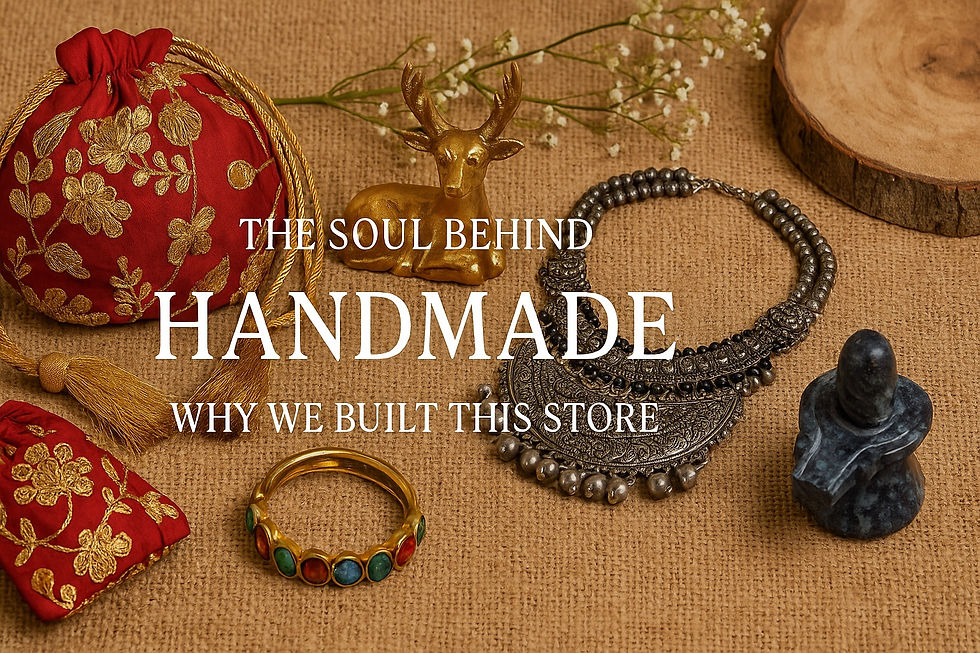
In a World of Fast Everything, We Chose to Slow Down
We live in a world where almost everything is designed to move faster.
Fast fashion.
Fast furniture.
Fast deliveries.
Fast trends.
New products appear every day, and what is new today can feel ordinary tomorrow.
But handmade objects follow a different rhythm.
They take time.
A material has to be selected. A technique has to be remembered. A shape has to be formed. A surface has to be finished. Sometimes a pattern has to be embroidered, carved, woven or cast by hand.
And behind every one of those steps is a person.
That is where our fascination with handmade began.
What We Saw in Varanasi
Our journey towards handmade craftsmanship was shaped by our experiences in Varanasi.
As we explored its lanes, workshops and craft traditions, we began to notice something that is easy to miss when we look only at the finished product.
The real story was in the hands that made it.
We encountered artisans whose skills had been developed over years and, in many cases, passed through generations.
Some worked with wood.
Some with metal.
Some with textiles.
Some with materials that required a completely different set of skills.
Their surroundings might have been modest, but the knowledge in their hands was extraordinary.
That experience became one of the foundations of what Athizay would eventually become.
From an Artisan's Skill to an Athizay Philosophy
Our first Athizay story tells how a chance encounter with an artisan in Varanasi became the spark for a much larger journey.
But the idea did not stop at discovering beautiful things.
We began asking a different question:
What happens when the person who makes something does not have the same access to the market as the person who wants to buy it?
There is often a gap between craftsmanship and consumers.
An artisan may possess extraordinary skill but have limited access to wider markets, changing consumer preferences, digital platforms or customers beyond their immediate region.
We wanted Athizay to become part of that bridge.
Not by changing the essence of the craft, but by helping more people discover it.
Why Handmade Matters
A handmade object is not necessarily better simply because it is handmade.
What makes it meaningful is the skill, time, material and human judgement that go into creating it.
When something is made by hand, small variations naturally occur.
A carving may not be perfectly identical to another.
A woven surface may carry subtle differences.
A piece of natural stone may have its own colour, grain or texture.
These variations are part of the character of handmade craftsmanship.
Uniformity is useful. Individuality is beautiful.
And in a world increasingly surrounded by identical objects, that individuality has its own value.
Indian Handicrafts: Where Skill Becomes Heritage
India's handicraft traditions are extraordinarily diverse.
Different regions have developed their own materials, techniques, motifs and forms of craftsmanship.
There are traditions of:
Metalwork
Woodcraft
Stone carving
Textiles
Embroidery
Jewellery
Pottery
Basketry
Decorative arts
Religious and ritual objects
Some techniques are centuries old.
Others continue to evolve as artisans respond to changing materials, markets and contemporary tastes.
This is what makes Indian handicrafts a living tradition rather than something frozen in history.
The Artisan Is Not Just a Maker
It is easy to describe an artisan as someone who makes a product.
But that description misses something important.
An experienced artisan often carries knowledge that cannot simply be written down in a manual.
They know how a particular material behaves.
How much pressure to apply.
When a surface is ready.
How a tool should move.
How a traditional motif should be interpreted.
Some of this knowledge is learned through observation.
Some through repetition.
Some through years of making mistakes and correcting them.
And some simply becomes part of the hands.
That is why craftsmanship is also a form of knowledge.
When Skills Travel Across Generations
One of the most beautiful aspects of Indian craftsmanship is the way knowledge can move from one generation to another.
A child may grow up watching a parent work.
A young apprentice may spend years learning beside an experienced craftsman.
A traditional technique may survive because someone decided to teach it rather than let it disappear.
In this way, a handmade object can carry more than the identity of the person who made it.
It can carry a lineage of knowledge.
That is what makes craft preservation important.
When a traditional craft survives, it is not only the product that survives.
The knowledge behind the product survives too.
What We Mean by "Handmade"
At Athizay, handmade does not mean that every single part of every product must be made entirely by hand.
Different crafts use different combinations of traditional tools, machinery and manual processes.
What matters to us is the human craftsmanship and skill at the heart of the creation.
A tool may help an artisan.
A machine may make one stage more precise.
But the design, material choices, finishing, judgement and craft knowledge can still depend heavily on the human hand.
This distinction matters because authentic craftsmanship is not about rejecting every modern tool.
It is about preserving the human knowledge that gives a craft its identity.
From Craft to Contemporary Homes
We also believe that traditional craftsmanship does not have to remain confined to traditional settings.
A handcrafted Indian object can find a place in a contemporary home.
A brass diya can sit beside modern décor.
A traditional textile can become part of a contemporary outfit.
A handcrafted potli can accompany a modern celebration.
A naturally carved stone Shiva Lingam can become part of a home's prayer space.
This meeting between tradition and contemporary life is something we find particularly inspiring.
Heritage stays alive when it continues to have a place in the present.
What Your Choice of Handmade Supports
Choosing a handcrafted product can mean choosing to value:
SkillThe knowledge required to create something well.
TimeThe hours and years behind the finished piece.
IndividualityThe subtle variations that make handmade objects distinctive.
TraditionThe techniques and knowledge passed between generations.
Human creativityThe imagination and judgement behind the work.
But we also believe it is important not to romanticise craftsmanship.
Supporting artisans should go beyond simply using words such as traditional, ethical or handmade.
It should involve responsible sourcing, fair and transparent relationships, respect for craftsmanship, and honest communication about what a product actually is.
What We Try to Do at Athizay
Athizay's role has evolved over time.
We discover.
We curate.
We research.
We tell stories.
And we bring together handcrafted creations that we believe have something meaningful to offer.
Sometimes that meaning comes from the craftsmanship.
Sometimes from the material.
Sometimes from the tradition behind it.
And sometimes from the way an object becomes part of someone's home, celebration or personal ritual.
Our aim is not simply to put another product in front of you.
It is to help you understand what you are looking at.
Beyond the Product
This belief is also why we have started expanding the stories we tell.
A Shiva Lingam, for example, is not simply a stone object.
It has a long spiritual and cultural history.
A Bilva leaf is not merely a leaf when it is placed before Lord Shiva.
A handcrafted textile is not simply fabric when its technique represents generations of regional knowledge.
Understanding the story behind something changes the way we see it.
And that is something we want Athizay to encourage.
Look closer. Ask questions. Understand the story.
From Hands to Heart
There is a simple journey behind every handmade object:
Material → Skill → Hands → Craft → Object → Story
But there is one more step.
Connection.
The object eventually reaches another person's hands.
It becomes part of a home.
A gift.
A celebration.
A ritual.
A memory.
And the journey that began with the artisan continues with the person who chooses to bring that piece into their life.
That is the connection we mean when we say:
Handmade is more than a product.

Tradition Meets Modern Life
Modern life often gives us speed and convenience.
Handmade reminds us of another value:
intentionality.
We take a little more time to look at the material.
We notice the texture.
We see the small variations.
We learn where something came from.
We understand that someone spent time making it.
Perhaps that is one reason handmade craftsmanship continues to resonate even in a world dominated by mass production.
It invites us to slow down—not necessarily everywhere, but at least for a moment.
Our Journey Continues
The story of Athizay did not begin with a catalogue of products.
It began with curiosity.
With seeing an artisan at work.
With discovering that behind the visible world of Indian handicrafts lies another world of knowledge, skill and tradition.
That curiosity continues to shape us.
Today, our exploration extends across jewellery, textiles, bags, brassware, decorative objects, sacred pieces and other expressions of Indian craftsmanship.
And alongside the products, we continue to explore their stories.
Because we believe that the more we understand heritage, the more meaningfully we can appreciate it.
From the Athizay Heritage Desk
Our first Athizay story was an ode to the Indian artisan.
This story is about the belief that grew from that journey:
Handmade deserves to be seen, understood and valued.
We don't believe every handmade object needs to be old.
We don't believe traditional craftsmanship needs to remain unchanged.
And we don't believe heritage belongs only in museums.
We believe heritage remains alive when skilled hands continue to create, when
knowledge continues to be passed on, and when people continue to find meaning in
what is made.
That is the soul behind handmade.
And that is a part of the soul behind Athizay.
📚 Continue Exploring Athizay
The journey doesn't end here.
Continue exploring stories about Indian artisans, handicrafts and the living traditions behind the things we bring into our homes.
Want to discover the story where Athizay's journey began?
Read Athizay Handicrafts: An Ode to the Indian Artisan and travel back to the Varanasi experience that first sparked our fascination with India's artisans.
Curious about the people and skills that give Indian handicrafts their soul?
Want to discover how Indian craftsmanship connects with the wider Asian craft tradition?
Continue with What Indian Handicrafts Teach Us About Asian Craft Culture.
Final Thoughts
A handmade object begins long before it reaches a shelf.
It begins with knowledge.
With material.
With practice.
With patience.
And with a pair of hands that knows what to do.
That is the soul behind handmade.
And perhaps the next time you hold a handcrafted object, you might pause for a moment and look beyond its shape and appearance.
Think about the person who made it.
The skill they carry.
The tradition they may be continuing.
And the story that has travelled from their hands to yours.
That is why handmade matters to us.
That is why we built Athizay.


Comments