
How to Perform Shiva Abhishek at Home
Updated: 16 hours ago
A Simple Guide to the Sacred Ritual of Shiva Lingam Abhishek
📚 Athizay Heritage Series – Part 4

When Water Becomes an Offering
There is something deeply calming about watching water flow slowly over a Shiva Lingam.
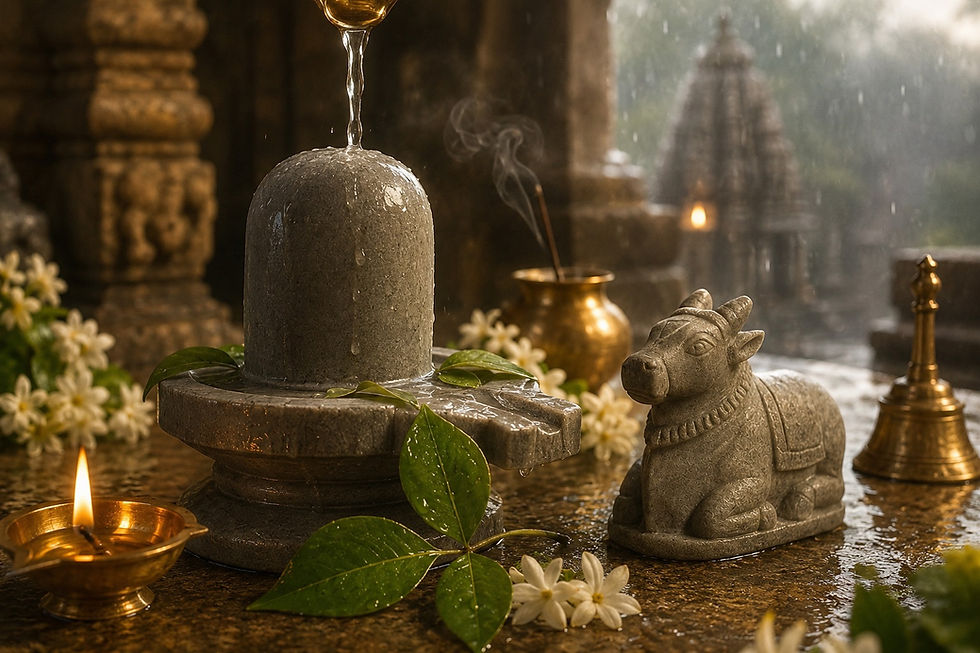
A stream of water touches the stone, travels across the sacred base, and gently flows away. A Bilva leaf is placed with care. A diya flickers nearby. The sound of water blends with the quiet repetition of "Om Namah Shivaya."
This simple ritual is known as Abhishek or Abhishekam.
For devotees, it is more than bathing a sacred form.
It is an act of offering, surrender, gratitude, and remembrance.
During Shravan, Shiva Abhishek becomes especially visible across homes and temples, but the practice is not limited to one month. Many devotees perform simple Abhishek as part of their regular Shiva worship.
So how can you perform Shiva Abhishek at home?
What should you offer?
What does the water represent?
And does a simple Abhishek require an elaborate collection of materials?
Let's explore the ritual step by step.
What Is Shiva Abhishek?
The Sanskrit word Abhisheka refers to a ceremonial bathing or anointing of a sacred image or deity.
In Shiva worship, Shiva Abhishek involves gently offering water and, according to different traditions, other sacred substances over the Shiva Lingam while prayers or mantras are recited.
Water is among the simplest and most widely used offerings. Traditional temple practices may also include milk, curd, honey, ghee, sandalwood and other offerings depending on the occasion and regional tradition.
The ritual is therefore not about how many substances are used.
The essence lies in the spirit of the offering.
Why Do Devotees Perform Abhishek on the Shiva Lingam?
There are several layers to the practice.
On a devotional level, Abhishek is an expression of love and reverence toward Lord Shiva.
On a symbolic level, the flowing water can represent purity, surrender and the continuous flow of consciousness.
And on a personal level, the ritual creates a moment in which the devotee slows down, becomes attentive, and turns inward.
The hands perform a simple action.
The mind follows it.
The prayer gives the action meaning.
The Connection Between Shravan and Shiva Abhishek
The connection becomes especially meaningful during Shravan.
As we explored in Part 2 of the Athizay Heritage Series, Shravan is traditionally associated with Lord Shiva and is a month of prayer, fasting, temple visits and devotional practices.
Water offerings become especially prominent during this period.
The monsoon itself provides a beautiful backdrop to the ritual. The earth receives rain and becomes renewed, while devotees symbolically offer water to Shiva as an expression of devotion.
Nature receives water. The devotee offers water.
Both become expressions of renewal.
What Do You Need for Shiva Abhishek at Home?
A simple Abhishek does not require a large collection of puja materials.
You can begin with:
A Shiva Lingam
Clean water
A small Abhishek vessel or lota
Fresh flowers
A diya
Incense, if desired
A clean cloth for preparing the puja space
Optional traditional offerings may include milk, curd, honey, ghee, sandalwood paste or Panchamrit, depending on your family tradition.
Many temple traditions use multiple offerings during Abhishekam, but a simple water Abhishek is perfectly appropriate for a home devotional practice.
Step 1: Prepare Yourself and the Space
Begin by taking a bath and wearing clean clothes.
Clean the area where you will perform the puja.
Place the Shiva Lingam securely on its Jaladhari, ensuring that the outlet allows the offering to flow away properly.
Arrange your diya, Bilva leaves, flowers and other offerings nearby.
There is no need to make the setting elaborate.
A clean and peaceful space is enough.
Step 2: Begin With a Quiet Prayer
Before beginning the Abhishek, take a moment to settle yourself.
You may close your eyes and silently offer a simple intention:
"May this prayer bring clarity to my thoughts, purity to my intentions, and peace to my actions."
The exact words are not important.
The sincerity is.
Step 3: Begin the Jal Abhishek
Fill a clean lota or Abhishek vessel with water.
Gently pour the water over the top of the Shiva Lingam, allowing it to flow naturally over the stone and into the Jaladhari.
There is no need to pour forcefully.
A slow and steady stream creates a more contemplative ritual.
As you pour, you may chant:
Om Namah Shivaya.
The mantra can be repeated slowly and with attention.

Why Is Water the Most Common Offering?
Water is fundamental to life and carries powerful symbolism across Indian traditions.
In Shiva Abhishek, its flowing movement is often understood as an expression of purity, humility and surrender.
The water does not remain on the Lingam.
It arrives, touches the sacred form, and flows onward.
There is something beautiful in that simplicity.
Offer. Let go. Move forward.
Step 4: Offer Bilva Leaves
After the Jal Abhishek, fresh Bilva (Bel) leaves may be offered to Lord Shiva.
The Bilva leaf has a particularly sacred place in Shiva worship, and its three leaflets carry several traditional interpretations.
Choose clean, fresh leaves and place them gently as part of your offering according to your family or temple tradition.
If Bilva leaves are not available, do not feel that your worship is incomplete.
A sincere prayer does not depend upon having every ritual item.

Did You Know?
The Bilva leaf is naturally trifoliate—three leaflets joined together.
In Shiva traditions, these three parts have been interpreted in different ways, including associations with the three gunas, the three states of consciousness and other sacred triads.
The symbolism ultimately points toward something deeper: moving beyond multiplicity toward the consciousness represented by Shiva.
Step 5: Offer Flowers
Fresh flowers may be offered after the Abhishek.
White flowers are commonly associated with Shiva worship, although practices vary between traditions and regions.
Place the flowers gently rather than covering the Shiva Lingam excessively.
The beauty of the ritual lies in its simplicity
Step 6: Light the Diya
Light a diya near your prayer space.
The flame represents light and is traditionally associated with auspiciousness and the removal of darkness.
As the diya burns, take a few moments to sit quietly.
This is often the part of the ritual that is easiest to overlook—and perhaps the most valuable.
Do not rush to the next task.
Allow yourself a few moments of stillness.
Step 7: Chant or Sit in Silence
You may continue chanting Om Namah Shivaya, recite a Shiva stotra, or simply sit quietly.
There is no requirement to turn every home Abhishek into a lengthy ceremony.
Sometimes five minutes of sincere attention can be more meaningful than an elaborate ritual performed without presence of mind.
What Other Offerings Are Used in Shiva Abhishek?
Different traditions and occasions use different substances.
Common offerings can include:
Milk
Milk is traditionally used in many forms of Shiva Abhishekam.
Curd
Curd may be included in more elaborate Abhishek rituals.
Honey
Honey is another traditional offering used in certain forms of Abhishekam.
Ghee
Clarified butter may be included, particularly in Panchamrit traditions.
Panchamrit
Panchamrit, meaning "five nectars," traditionally combines five ingredients—commonly milk, curd, ghee, honey and sugar. Practices and recipes can vary.
These offerings are documented in various Shiva worship traditions, but they are not all necessary for a simple home Abhishek.
Is Milk Abhishek Necessary?
No.
Water alone is sufficient for a simple and sincere Jal Abhishek.
This is worth emphasizing because devotional practice can sometimes become unnecessarily complicated.
If you choose to use milk or other substances, use them respectfully and according to your family's tradition.
For regular home worship, a simple offering of clean water, followed by Bilva leaves and prayer, can be both meaningful and practical.
A Note on Responsible Offerings
A sacred ritual should also be performed with awareness.
If using milk, honey or other food substances, avoid unnecessary quantities.
The intention of Abhishek is devotion, not consumption of resources for display.
A small offering made sincerely can carry more meaning than an excessive one.
This approach also makes regular Shiva worship easier for families who want to maintain a simple daily or weekly practice.
Can You Perform Shiva Abhishek Every Day?
Many devotees perform simple Shiva worship daily, while others choose Mondays, Pradosh, Shravan, Mahashivratri or other personally significant days.
There is no need to make daily worship elaborate.
A simple routine can be:
Water → Bilva leaf → Diya → Mantra → Quiet prayer
The consistency of the practice can become more meaningful than its complexity.
How Long Should Shiva Abhishek Take?
There is no universal time requirement for a simple home Abhishek.
It can take just a few minutes or become part of a longer puja.
What matters is that the ritual is performed respectfully and according to your family's or spiritual tradition.
Can You Perform Abhishek Without a Priest?
Yes.
Many devotees perform simple Shiva worship at home without a priest.
If you are performing a more elaborate Vedic ritual, Rudrabhishek, or a ceremony involving specific mantras and procedures, you may choose to seek guidance from a qualified priest or your family tradition.
For everyday devotional worship, simplicity is perfectly appropriate.
Tradition Meets Modern Life
One reason Abhishek remains so meaningful in contemporary homes is its rhythm.
Pouring water slowly.
Repeating a mantra.
Watching the flame of a diya.
Placing a Bilva leaf with care.
These actions naturally create pauses in an otherwise busy day.
Modern research has explored how practices involving meditation, rhythmic repetition and focused attention may relate to stress and psychological well-being. But these findings should not be used to claim that the ritual itself has scientifically proven spiritual or medical effects.
For devotees, the primary purpose remains spiritual.
Abhishek creates a moment to stop, remember, and reconnect.
A Simple 10-Minute Shiva Abhishek
If you are new to Shiva worship, you can begin with this simple routine.
Before the puja
Bathe and wear clean clothes.
Clean your prayer space.
Place the Shiva Lingam securely on the Jaladhari.
Keep water, Bilva leaves and flowers ready.
During the Abhishek
Light the diya.
Take a quiet moment to pray.
Pour clean water slowly over the Shiva Lingam.
Chant Om Namah Shivaya.
Offer Bilva leaves.
Offer flowers.
After the Abhishek
Sit quietly for a few moments.
Offer your personal prayer.
Express gratitude.
Clean the surrounding area respectfully.
That's it.
You do not need an elaborate altar.
You do not need dozens of offerings.
You need a sincere intention and a moment of attention.
The Deeper Meaning of Abhishek
Perhaps the most beautiful lesson of Abhishek lies in the act itself.
We pour water over the Shiva Lingam.
But what are we really offering?
Our restlessness.
Our worries.
Our distractions.
Our ego.
Our gratitude.
Our hopes.
The water flows away, reminding us that everything we hold onto eventually has to move forward.
In this sense, Abhishek becomes more than a ritual.
It becomes a practice of letting go.
Shiva Abhishek During Shravan
During Shravan, the ritual takes on a particularly devotional atmosphere.
The sound of rain outside.
The scent of wet earth.
Fresh Bilva leaves.
A glowing diya.
Water flowing over the Shiva Lingam.
For many devotees, these simple elements make Shravan worship feel deeply connected to the rhythm of nature itself.
As we explored in Part 3, Shravan is also a season of discipline and renewal.
Abhishek complements that spirit beautifully:
The month encourages inner renewal.
The vrat encourages discipline.
The Abhishek gives that devotion a physical expression.
Frequently Asked Questions
What is Shiva Abhishek?
Shiva Abhishek is a traditional Hindu ritual in which water and, depending on the tradition, other sacred offerings are poured or offered over a Shiva Lingam during worship.
What is the simplest Shiva Abhishek?
A simple Jal Abhishek with clean water, followed by Bilva leaves, a diya and prayer, is enough for a basic home devotional practice.
Can I perform Shiva Abhishek at home?
Yes. Many devotees perform simple Shiva worship at home without a priest.
Which mantra should I chant during Abhishek?
Om Namah Shivaya is one of the most widely used mantras in Shiva worship.
Can I use only water?
Yes. Water is one of the most common and simplest offerings used in Shiva Abhishek.
Do I need milk for Shiva Abhishek?
No. Milk is a traditional offering in many forms of Abhishekam, but it is not necessary for a simple home Jal Abhishek.
How often can I perform Shiva Abhishek?
This depends on your personal practice and family tradition. Some devotees worship daily, while others perform Abhishek on Mondays, during Shravan, Pradosh, Mahashivratri or other sacred occasions.
What should I do with the water after Abhishek?
Allow the water to drain through the Jaladhari as intended and keep the surrounding worship area clean. Follow your family's or temple's established practice for handling offerings.
From the Athizay Heritage Desk
Rituals survive across generations not because they are complicated, but because they continue to carry meaning.
Shiva Abhishek is one such ritual.
A handful of water.
A green Bilva leaf.
A small flame.
A sacred mantra.
Simple actions become meaningful when performed with awareness.
At Athizay, we believe that understanding the meaning behind a tradition makes the experience of practising it even more beautiful.
The Athizay Heritage Series explores these traditions not simply as rituals of the past, but as living expressions of India's cultural and spiritual heritage.
📚 Continue Your Spiritual Journey
Athizay Heritage Series – Shiva Knowledge Hub
Coming Next:
Part 6: The Story of Samudra Manthan and Lord Shiva
Final Thoughts
Shiva Abhishek does not ask for extravagance.
It asks us to pause.
To pour.
To remember.
To let go.
Whether performed during Shravan Somvar, on a quiet morning, or as part of a special family tradition, the ritual offers a simple way to bring devotion into everyday life.
As the water flows over the Shiva Lingam, perhaps we can allow something within ourselves to flow away too—the unnecessary worry, the restless thought, the weight we have been carrying.
And when the water has finished flowing, what remains is a little more stillness.
A little more clarity.
A little more devotion.
Om Namah Shivaya.

Comments