
Why Are Bilva Leaves Offered to Lord Shiva?
The Meaning, Symbolism & Sacred Tradition Behind the Bel Patra
📚 Athizay Heritage Series - Part 5
Previously: How to Perform Shiva Abhishek at Home

A Simple Leaf With a Sacred Place in Shiva Worship
Among the many offerings placed before Lord Shiva, few are as closely associated with Him as the Bilva leaf.
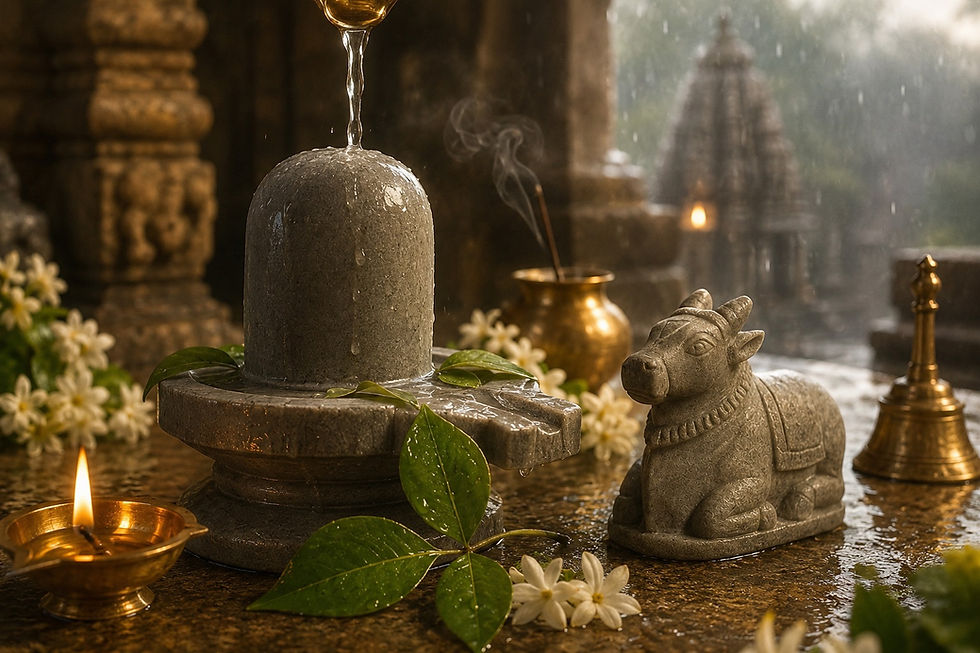
A devotee may arrive at a Shiva temple carrying little more than a handful of fresh green leaves. After the Jal Abhishek, the leaves are gently placed upon the Shiva
Lingam, often accompanied by the quiet chanting of:
Om Namah Shivaya.
The ritual looks simple.
But behind this simple offering lies centuries of tradition, symbolism, mythology, and reverence for the Bilva tree.
Why is this particular leaf considered sacred to Lord Shiva?
Why does it usually appear as three leaflets joined together?
Is there a story behind its association with Shiva?
And how should Bilva leaves be offered during home puja?
Let's explore the tradition.
What Is the Bilva Leaf?
The Bilva tree, also called Bael, is botanically known as Aegle marmelos.
It is a tree native to the Indian subcontinent and has been valued in Indian traditions for centuries.
Its distinctive leaf is usually composed of three leaflets joined at a common point, giving it a form that has become deeply connected with Shiva worship.
In Sanskrit and many Indian languages, the tree and its fruit are known by different regional names, while Bilva and Bel are among the most familiar.
But its importance in Shiva worship goes far beyond its botanical identity.
Why Is Bilva Sacred to Lord Shiva?
The Bilva leaf has a long-standing place in Hindu traditions dedicated to Lord Shiva.
Its three-part form has inspired several sacred interpretations.
Depending on the tradition, the three leaflets may be associated with:
The three qualities or gunas
The three syllables of AUM
The three aspects of divine reality
Lord Shiva's Trishula
Various sacred triads found throughout Hindu philosophy
The interpretations are not necessarily identical across every scripture or tradition.
What remains consistent is the deep symbolic relationship between the threefold Bilva leaf and Shiva.

Did You Know?
The Bilva leaf is naturally trifoliate, meaning that one leaf commonly appears as three leaflets joined together.
This distinctive natural form is one reason it has acquired such rich symbolism in Shiva worship.
The Three Leaves and Lord Shiva
The number three appears repeatedly in the symbolism surrounding Lord Shiva.
We see it in the Trishula, the three horizontal lines of sacred ash known as Tripundra, and the threefold symbolism associated with many aspects of Shiva philosophy.
The Bilva leaf fits naturally into this visual language.
When devotees place its three leaflets before Shiva, the simple act becomes a reminder of these deeper ideas.
It is a beautiful example of how nature becomes part of sacred symbolism.
A leaf is not merely a leaf.
Its form becomes a way of remembering something larger.
The Bilva Tree in Sacred Tradition
The Bilva tree itself holds an important place in Hindu tradition.
References to Bilva can be found in ancient Indian religious literature, and the tree has remained closely associated with Shiva temples and devotional practices.
The tree is often planted near temples, and its leaves are traditionally collected for Shiva worship.
This has created a living relationship between the landscape and the ritual:
The tree grows.
The leaf is offered.
The offering becomes prayer.
Why Do Devotees Offer Bilva Leaves After Abhishek?
During Shiva worship, Bilva leaves are often offered after or alongside Jal Abhishek.
The flowing water cleanses the surface of the Shiva Lingam as part of the ritual, while the Bilva leaf becomes a separate, personal offering.
A devotee may gently place the leaves on the Shiva Lingam while chanting a mantra.
The ritual does not require an elaborate arrangement.
A few fresh leaves offered with sincerity are enough.
This simplicity is one of the reasons the practice remains so accessible.
How to Offer Bilva Leaves to Lord Shiva
If you are performing Shiva Puja at home, you can follow a simple traditional sequence.
1. Choose Fresh Leaves
Select fresh, clean Bilva leaves.
Traditionally, devotees prefer leaves that are intact and naturally formed.
2. Clean Them Gently
Rinse the leaves with clean water before offering them.
3. Prepare the Shiva Lingam
If performing Abhishek, gently offer clean water over the Shiva Lingam first.
4. Place the Bilva Leaves
Place the Bilva leaves gently on the Shiva Lingam according to your family or temple tradition.
5. Offer With a Prayer
You may chant:
Om Namah Shivaya
while making the offering.
The words are simple, but the intention behind them is what gives the ritual its personal meaning.
Is There a Correct Way to Place Bilva Leaves?
Practices can vary between traditions, temples, regions and families.
Some traditions prescribe particular ways of placing Bilva leaves, including how the leaflets should face the Shiva Lingam.
Rather than presenting one regional practice as a universal rule, it is best to follow the customs of your family, temple or spiritual teacher.
The important principle is to offer the leaves fresh, respectfully and with devotion.
Can You Offer Bilva Leaves Every Day?
Many devotees offer Bilva leaves during daily Shiva worship.
Others reserve them for Mondays, Shravan, Pradosh, Mahashivratri or other important occasions.
There is no need to wait for a festival to remember Lord Shiva.
At the same time, if fresh Bilva leaves are not available, your worship is not incomplete.
A simple offering of water and sincere prayer remains meaningful.
What If Bilva Leaves Are Not Available?
This is an important practical question.
You do not need to stop your Shiva worship simply because Bilva leaves are unavailable.
You can offer:
Clean water
Fresh flowers
A diya
Incense
Your prayers
A sincere recitation of Om Namah Shivaya
Devotion is not measured by the number of ritual objects available.
The Bilva leaf is special because of its traditional significance—not because Shiva worship becomes impossible without it.
The Bilva Tree: More Than a Sacred Symbol
The Bilva tree has also been valued in traditional Indian systems of knowledge.
Its fruit, leaves, bark and other parts have been used in Ayurvedic traditions.
The fruit is especially well known in traditional Indian food and wellness practices.
However, traditional use should not automatically be interpreted as modern medical evidence.
The sacred importance of Bilva in Shiva worship is a matter of religious and cultural tradition, while its botanical and traditional wellness uses belong to a different area of knowledge.
Keeping these distinctions clear helps us appreciate both without confusing one for the other.
Tradition Meets Modern Life
There is something remarkably relevant about the Bilva offering even in modern life.
A city dweller may have very little connection with the natural world during an ordinary day.
Yet a simple Shiva puja can bring a leaf, a flower, water and a flame into that person's daily routine.
The ritual reconnects us with natural elements.
Water.
Leaves.
Earth.
Fire.
Fragrance.
Perhaps this is one of the quiet beauties of Indian ritual traditions: they often bring nature into the centre of human life.
Bilva and the Spirit of Shravan
During Shravan, the connection becomes even more visible.
The monsoon transforms the landscape.
Trees become greener.
Fresh leaves emerge.
The earth is replenished.
And devotees bring offerings from nature into their worship.
The Bilva leaf becomes part of this seasonal rhythm.
As we explored in Part 2, Shravan is traditionally a month of devotion, discipline and renewal.
The Bilva offering adds another dimension:
A living leaf becomes an expression of gratitude.
A Small Offering, A Deeper Meaning
Perhaps the most beautiful thing about Bilva worship is its simplicity.
You do not need an elaborate arrangement.
You do not need a large quantity.
You do not even need to travel to a temple.
A few fresh leaves, a Shiva Lingam, some clean water and a sincere prayer can create a complete moment of devotion.
The leaf reminds us that sacredness does not always arrive in grand forms.
Sometimes it grows quietly on a tree.
Frequently Asked Questions
Why are Bilva leaves offered to Lord Shiva?
Bilva leaves have a long-standing association with Lord Shiva in Hindu tradition. Their naturally three-part form also carries several sacred interpretations connected with Shiva symbolism.
Why are there three leaves on a Bilva leaf?
Bilva leaves are naturally trifoliate, meaning they commonly have three leaflets. This natural form has inspired several symbolic associations in Hindu traditions.
Can Bilva leaves be offered every day?
Yes. Many devotees include Bilva leaves in daily Shiva worship, while others offer them on Mondays, during Shravan, Pradosh, Mahashivratri and other sacred occasions.
Can I worship Shiva without Bilva leaves?
Yes. Bilva leaves are a traditional offering, but they are not the only way to worship Lord Shiva. Water, flowers, a diya, mantra and sincere prayer can all form part of Shiva worship.
Can I offer dried Bilva leaves?
Practices vary. Fresh, clean leaves are generally preferred where available. If following a particular family or temple tradition, follow its guidance regarding dried leaves.
How should Bilva leaves be offered?
The exact method varies by tradition. Fresh, clean leaves are generally placed gently on the Shiva Lingam while offering prayers or chanting a Shiva mantra.
What is the scientific name of the Bilva tree?
The Bilva tree is scientifically known as Aegle marmelos.
Is Bilva the same as Bael?
Yes. Bilva and Bael (or Bel) are commonly used names for Aegle marmelos, although regional names can vary
From the Athizay Heritage Desk
India's heritage is often found in the smallest details.
A leaf.
A flower.
A diya.
A handful of water.
Each carries a story that has travelled across generations.
The Bilva leaf is one such story—a meeting point between nature, devotion and symbolism.
At Athizay, we believe that understanding these small details helps us appreciate the richness of India's living heritage.
Through the Athizay Heritage Series, we explore the stories behind the traditions, objects and rituals that continue to find a place in homes and hearts today.
📚 Continue Your Spiritual Journey
Athizay Heritage Series – Shiva Knowledge Hub
✅ Part 4: How to Perform Shiva Abhishek at Home
You are reading Part 5.
Coming Next:
→ Part 6: The Story of Samudra Manthan and Lord Shiva
→ Part 7: How to Choose a Shiva Lingam for Your Home
Final Thoughts
The Bilva leaf is small.
But its place in Shiva worship carries a story much larger than its size.
It connects the natural world with sacred symbolism, the simplicity of a leaf with the depth of devotion.
When a devotee gently places a Bilva leaf on the Shiva Lingam, the offering can become a quiet reminder:
Sacredness can be found in simplicity.
And perhaps that is why this humble leaf has remained, for generations, one of the most beloved offerings to Lord Shiva.
Om Namah Shivaya. 🔱

Comments